
📡 Learning Module Transcript
🎬 Module Introduction
Welcome to this advanced module on Wireless Networks and Software Defined Radio (SDR).
In this course, we will explore how mobile communication systems work—from legacy GSM networks to modern 5G—and examine real-world vulnerabilities that have been exploited by researchers and attackers.
This is not just theory. You’ll understand how signals travel, how protocols communicate, and where weaknesses exist.
⚠️ This module is strictly for educational and ethical hacking purposes.
📚 Learning Objectives
By the end of this module, you will be able to:
- Understand the architecture of GSM, GPRS, LTE, and 5G networks
- Explain how SS7 signaling works and why it is vulnerable
- Use SDR tools to analyze wireless signals
- Identify common attack vectors in mobile networks
- Understand how modern networks defend against these attacks
🧠 Lesson 1: Fundamentals of Wireless Communication
Wireless communication relies on transmitting data over radio frequencies (RF).
Key Concepts:
- Frequency Bands: GSM (900/1800 MHz), LTE (various bands), 5G (sub-6GHz & mmWave)
- Modulation: GMSK (GSM), QPSK, QAM
- Cells & Base Stations: Devices connect to nearby towers (BTS/eNodeB/gNodeB)
Narration:
When your phone connects to a network, it scans for nearby base stations. Once connected, it exchanges control signals and data through structured protocols.
📻 Lesson 2: Introduction to SDR (Software Defined Radio)


6
SDR allows you to receive and transmit radio signals using software instead of dedicated hardware.
Popular SDR Tools:
- RTL-SDR (cheap, receive-only)
- HackRF One (transmit & receive)
- USRP (professional-grade)
Software:
- GNU Radio
- SDR#
- GQRX
Narration:
Instead of buying expensive telecom equipment, SDR lets us simulate and analyze signals directly from a laptop.
📡 Lesson 3: GSM Network Architecture & Weaknesses


6
GSM Components:
- BTS (Base Transceiver Station)
- MSC (Mobile Switching Center)
- HLR/VLR (Subscriber databases)
Vulnerabilities:
- Weak encryption (A5/1, A5/2)
- No mutual authentication
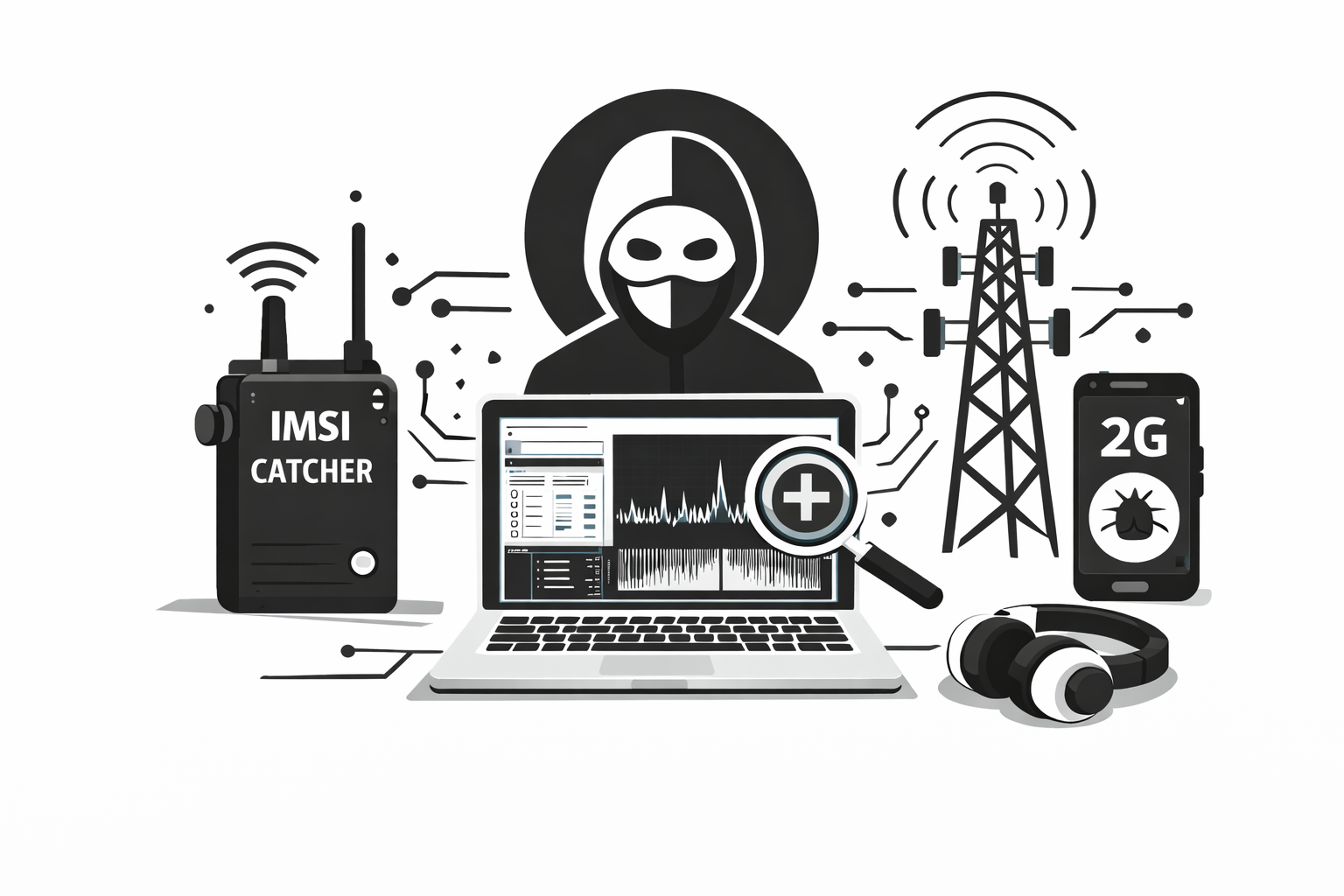
- Susceptible to IMSI Catchers
Attack Example:
An attacker sets up a fake base station. Phones connect automatically, revealing their IMSI.
🌐 Lesson 4: SS7 – The Hidden Backbone


SS7 is a signaling protocol used globally to route calls and SMS.
Key Problem:
SS7 assumes all network participants are trusted.
Attacks:
- Call interception
- SMS interception (2FA bypass)
- Location tracking
Narration:
If an attacker gains SS7 access, they can query your location or redirect your messages—without touching your phone.
📶 Lesson 5: GPRS & Data Communication Attacks
GPRS introduced packet-based data.
Weaknesses:
- Limited encryption
- Session hijacking possibilities
- Downgrade attacks (forcing device to GSM)
Attack Scenario:
An attacker forces a smartphone from LTE to GPRS, then exploits weaker encryption.
🚀 Lesson 6: LTE (4G) Security & Exploits


6
Improvements over GSM:
- Strong encryption (AES-based)
- Mutual authentication
- Better key management
Remaining Vulnerabilities:
- IMSI exposure during attach
- Fake base stations (still possible)
- Signaling attacks
🌐 Lesson 7: 5G Networks – Evolution & New Risks


6
New Features:
- Network slicing
- Ultra-low latency
- Enhanced encryption
Security Enhancements:
- Concealed identifiers (SUCI instead of IMSI)
- Improved authentication
New Risks:
- Virtualized infrastructure attacks
- Supply chain vulnerabilities
- Misconfigured network slices
🛠️ Lesson 8: Practical SDR Lab (Conceptual)
Tools Needed:
- RTL-SDR or HackRF
- Linux system (Ubuntu recommended)
- GNU Radio
Example Activities:
- Scan GSM frequencies
- Identify nearby base stations
- Analyze signal strength and channels
⚠️ Note: Transmitting or intercepting real communications without permission is illegal.
🔐 Lesson 9: Defense & Countermeasures
For Users:
- Use 4G/5G only (disable 2G if possible)
- Use encrypted apps (Signal, WhatsApp)
For Operators:
- SS7 firewalls
- Network monitoring
- Secure roaming agreements
For Security Professionals:
- RF monitoring
- Threat intelligence
- Red teaming telecom infrastructure
🧾 Module Summary
In this module, we explored:
- The evolution from GSM → 5G
- SDR as a powerful analysis tool
- Real-world telecom vulnerabilities
- How attackers exploit signaling and radio layers
- Defensive strategies in modern networks
🧪 Final Assignment
Task:
Design a threat model for a mobile network including:
- Attack surface (GSM, SS7, LTE, 5G)
- Possible attackers
- Mitigation strategies
🎓 Closing
Understanding wireless networks is critical for modern cybersecurity professionals.
Mobile networks are everywhere—and so are their vulnerabilities.
Mastering them puts you ahead in ethical hacking and telecom security.